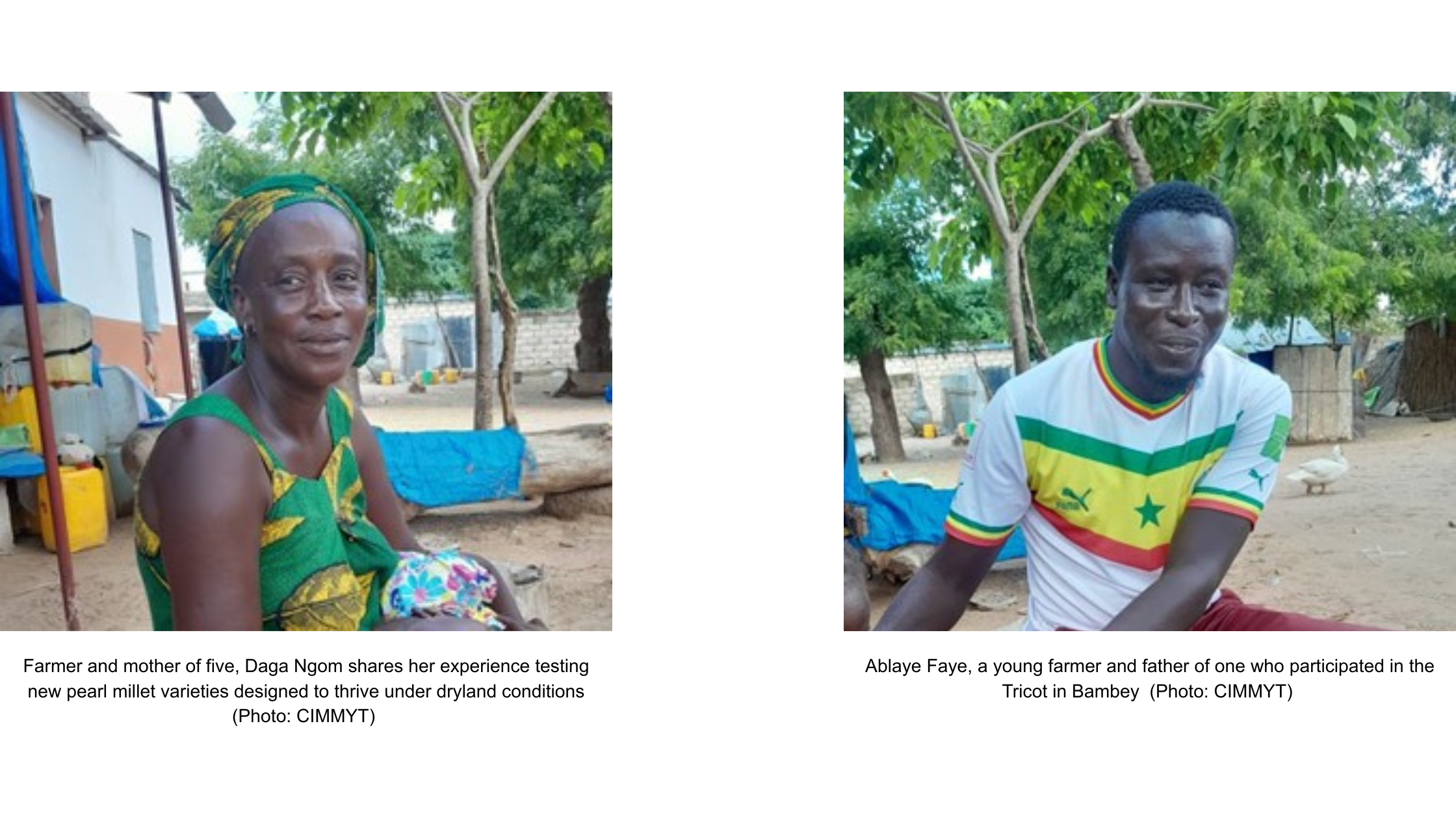
For many years, Ablaye Faye, a smallholder farmer from Bambey Serere in Senegal’s drylands, has depended on pearl millet to feed his family and earn a living. Like many farmers in the region, he has seen yields fluctuate sharply due to unpredictable rainfall, prolonged dry spells, declining soil fertility, and increasing pest pressure. With limited access to improved seed and inputs, coping with these challenges has become increasingly difficult, threatening both household food security and income stability.
In 2024, Faye joined a research initiative led by CIMMYT aimed at helping farmers identify pearl millet varieties better adapted to the realities of a changing climate. As part of the study, he planted three improved varieties side by side on his own field to compare their performance under local growing conditions. His participation was one of many similar trials conducted across Senegal to evaluate improved options for building resilience and improving productivity in dryland farming systems.
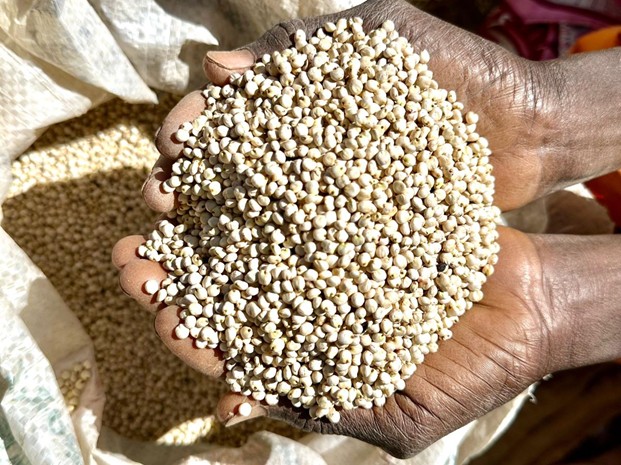
Pearl millet is a key crop for smallholder farmers in Senegal and across West and Central Africa, thriving where other crops cannot. Yet erratic rainfall, extended dry spells, and pest outbreaks have made it increasingly difficult to maintain stable yields. Recognizing this, CIMMYT partnered with MyAgro, a nonprofit social enterprise, to test and promote improved pearl millet varieties capable of performing reliably under these harsh conditions.
For Faye, the trial offered a firsthand opportunity to observe how different varieties performed in his own field. As the season progressed, differences among the crops became clear.
“At first, I couldn’t really see the difference between the varieties,” he explained. “But at harvest time, it was obvious, SL423 had larger grains and stronger plants. That’s the one I prefer and want to grow again.”
Farmer-led variety evaluation
The Triadic Comparison of Technologies (Tricot) trials use a participatory research approach that places farmers at the center of varietal evaluation. In this method, each participating farmer plants three different varieties on small, side by side plots within their own field. Rather than relying on a few demonstration sites, the trials are implemented across many villages to capture real world variation in soils, rainfall, and management practices. This design produces data that reflect actual farm conditions while ensuring that farmer observations directly inform the selection of the most promising varieties.
To extend the reach of this work, CIMMYT partnered with MyAgro, which supports smallholder farmers through a mobile layaway platform that allows them to gradually save for quality inputs such as seed and fertilizer. MyAgro’s village entrepreneur network and community training system provided an effective channel for coordinating the trials, distributing inputs, and collecting feedback.
CIMMYT provided technical leadership, designing the trials, supplying seed, and guiding monitoring and analysis, while myAgro managed farmer engagement and logistics. Together, the partners combined scientific rigor with local accessibility, creating an effective model for testing and scaling improved varieties.
The trials were implemented in 20 villages across Kaolack, Bambey, Diourbel, and Thiadiaye, engaging 250 farmers, half of them women. Farmers were trained on trial establishment, management, and recordkeeping, and evaluated three pearl millet varieties — SL423, SL169, and Thialack 2, one of Senegal’s most widely grown. They monitored performance for germination, drought and pest tolerance, plant vigor, and yield throughout the season.
Results revealed clear regional patterns: SL423 performed best in Diourbel and Bambey, while Thialack 2 showed strong results in Kaolack and Thiadiaye. Overall, 41% of farmers selected SL423 as their preferred variety for its resilience and yield potential.
“We were trained on how to use the new seeds and fertilizer, and we saw great results,” said Daga Ngom, another farmer from Bambey Serere. “One of the varieties matured earlier than the others, and that’s the one I planted again this season.”
Building the foundation for scale
Beyond on-farm testing, the partnership between CIMMYT and MyAgro focuses on strengthening the systems that make improved varieties accessible to more farmers. Through its village entrepreneur network and training teams, MyAgro reached more than 210,000 farmers across Senegal with door-to-door outreach and monthly training sessions, raising awareness about new varieties and improved agronomic practices.
CIMMYT’s collaboration with MyAgro ensures that varieties proven through scientific testing and field validation move beyond research plots into widespread use. Once a variety demonstrates strong performance and farmer preference, it is integrated into MyAgro’s core input packages, available through the organization’s mobile layaway platform that allows smallholders to save gradually toward the purchase of seed and fertilizer.
Strengthening local seed systems and driving impact
A central focus of CIMMYT’s work in Senegal is building a seamless pathway from research and development to farmer adoption. This is made possible through a coordinated partnership with the Institut Sénégalais de Recherches Agricoles (ISRA) and MyAgro, aligning CIMMYT’s scientific innovation with ISRA’s national research leadership and MyAgro’s farmer delivery network.
CIMMYT works closely with ISRA to develop and validate new pearl millet varieties and maintain a steady supply of early-generation seed (EGS) for multiplication. This foundation enables local seed producers to scale up quality seed production.
On the delivery end, MyAgro partners with government-certified seed cooperatives to strengthen the supply chain. Using its digital layaway platform and extensive farmer network, MyAgro forecasts seed demand early in the season and shares this information with cooperatives, helping them plan production, invest confidently, and ensure that certified seed is available where and when farmers need it.
Together, CIMMYT, ISRA, and MyAgro form a connected pipeline that links research, seed production, and farmer access—ensuring that innovations developed through science translate into real benefits in farmers’ fields.
“Our focus is to ensure that farmers in dryland regions can access improved, climate-resilient pearl millet varieties that respond to local needs,” said Dr. Doris Puoza, Scientist with CIMMYT’s Dryland Crops Program. “Through strategic partnerships like this, we are bridging the gap between research and delivery ensuring that innovation translates into impact where it matters most.”
This integrated approach strengthens Senegal’s seed sector, helping it deliver improved varieties to farmers while building resilience across dryland farming systems in the face of climate change.

 Dryland Crops