
$3.5-4.0 billion annually
generated on benefits

69 maize and 62 wheat
varieties resulting from our work in 2022

1,185
staff of 52 nationalities
WHO WE ARE
CIMMYT is a cutting edge, non-profit, international organization dedicated to solving tomorrow's problems today.
Learn more
generated on benefits
varieties resulting from our work in 2022
staff of 52 nationalities
AREAS OF EXPERTISE
We leverage our expertise to sustainably improve the resilience of smallholder farmers in the Global South for a more productive, inclusive, and environmentally sound agrifood system.
The award addresses food insecurity and acknowledges projects that prioritize the...
 Gender equality, youth and social inclusion, Innovations
Combining diversification strategies boosts synergies and reduces tradeoffs.
Capacity development, Environmental health and biodiversity,
As CIMMYT strives towards ensuring all employees can reach their full...
Gender equality, youth and social inclusion
Mexico, with CIMMYT, blocked 1,463 risky shipments, protecting against 258 pests...
Nutrition, health and food security
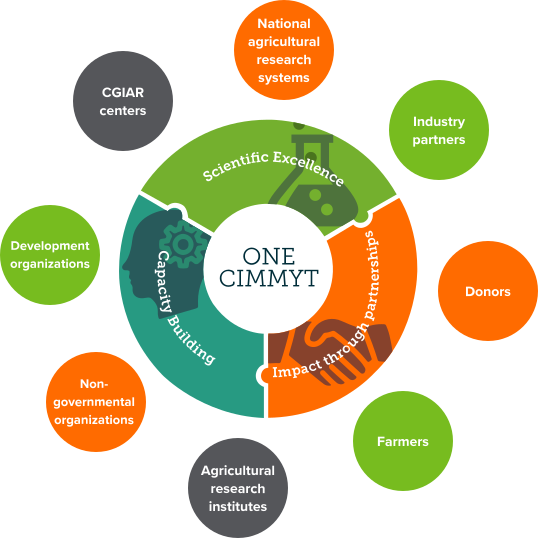
HOW WE WORK
CIMMYT links scientific excellence, impact through partnerships and capacity building. “One CIMMYT” integrates these domains. CIMMYT transforms research into large-scale farm-level impacts through strong, long-established partnerships.
More about usOUR PRESENCE
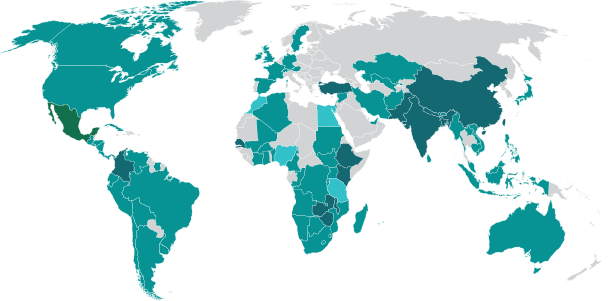
With projects in 88 countries, CIMMYT collaborates with hundreds of partners and is part of the global network of CGIAR Research Centers, delivering science for a food-secure future.
CIMMYT global headquarters
Carretera México-Veracruz, Km. 45, El Batán 56237 Texcoco, Mexico


Bangladesh
House #10/B, Road #53, Gulshan-2, Dhaka 1212, Bangladesh
China
Chinese Academy of Agricultural Sciences (CAAS), 12 Zhongguancun South Street, Beijing 100081, China
Colombia
Km. 17, Recta Cali-Palmira, Valle del Cauca, Colombia
Ethiopia
ILRI Sholla Campus, CMC Road, Addis Ababa, Ethiopia
India
G2, B Block, National Agricultural Science Centre Complex (NASC), Dev Prakash Shastri Marg, New Delhi, Delhi 110012, India
Kenya
ICRAF House, United Nations Avenue, Gigiri, Nairobi, Kenya
Nepal
Agriculture Botany Division - 1st floor, NARC Research Station, Khumaltar, Lalitpur 44700, Nepal
Pakistan
Crop Sciences Institute (CSI) Complex, National Agricultural Research Center (NARC), Park Road, Islamabad, Pakistan
Turkey
Gayret Mahallesi Sehit Cem Ersever Caddesi 9/11, Tarla Bitkileri Arastirma Enstitusu, 06170, Yenimahalle, Ankara, Turkey
Zimbabwe
12.5 KM Peg, Mazowe Road, Mount Pleasant, Harare, Zimbabwe
Senegal
Egypt
Malawi
Morocco
Nigeria
Tanzania
Zambia
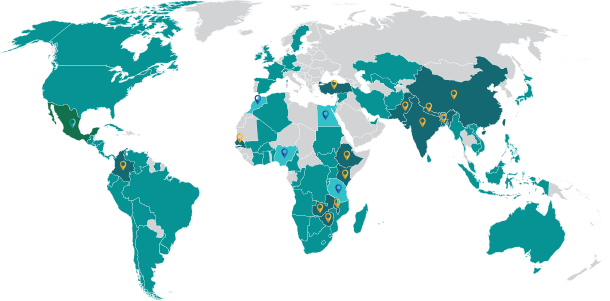
 Headquarters
 Office
 Satellite Office
Bangladesh China Colombia Egypt Ethiopia India Kenya Malawi Mexico Morocco Nepal Nigeria Pakistan Senegal Tanzania Turkey Zambia Zimbabwe
Satellite Office
Bangladesh China Colombia Egypt Ethiopia India Kenya Malawi Mexico Morocco Nepal Nigeria Pakistan Senegal Tanzania Turkey Zambia Zimbabwe*As of November 1, 2023
**All CIMMYT activities/operations are conducted in accordance with OFAC guidelines
September 22 - September 27


